

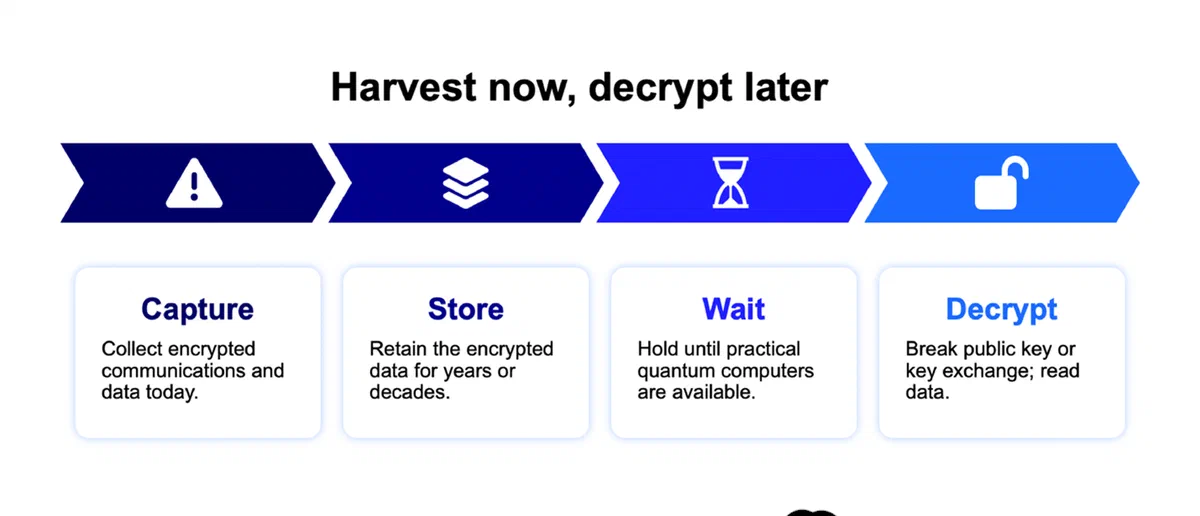
The dependence of European governments on American cloud infrastructure poses more than just an immediate interception problem. The great revelation, the most devastating threat for decades to come, is what intelligence specialists call the HNDL: “Harvest Now, Decrypt Later” strategy.
This is not a frontal intrusion, but a silent theft. Intelligence agencies and state adversaries are intercepting and storing immense amounts of encrypted data today, simply because the cost of storage has become negligible.
They wait patiently for the moment when technological leaps and the unpredictable evolution of computing power will render current cryptographic keys obsolete. What constitutes a protected state secret in 2026 could become an open book in fifteen or twenty years.
Retroactive Liability and Temporal Risk
The HNDL model introduces a novel concept: delayed legal harm. Traditionally, a breach of secrecy is a static event. With the massive collection of data for future decryption, confidentiality becomes a time-dependent variable.
To quantify this risk, the HNDL scientific model defines that confidentiality inevitably fails when the required lifespan of the secret exceeds the adversary’s decryption horizon. Sectors of critical exposure are currently in a state of latent vulnerability.
If a state or an organization does not guarantee the absolute sovereignty of its hardware infrastructure, it is practically signing a waiver of long-term confidentiality for its citizens and institutions.
Today’s interception is tomorrow’s compromise. Turning cloud dependence into a national security debt is a gamble impossible to repay.
The Arpokrat Antithesis: Legal Impossibility by Code
Faced with this vulnerability, the industry is responding by creating radical digital sovereignty ecosystems. The Arpokrat model emerges as the perfect antithesis to centralized messaging: this architecture operates on a decentralized network, protected by the very strict Federal Act on Data Protection (FADP) in Switzerland.
The core logic is one of absolute Privacy by Design. By removing the need to provide a phone number, the user becomes a simple cryptographic key, devoid of physical identity.
Legally, this drastically changes the rules of the game. If the architecture is fundamentally Zero-Knowledge and non-custodial, the company faces a technical impossibility to comply with foreign warrants.
This is not civil disobedience against extraterritorial laws, but an unstoppable mathematical and legal safeguard: what you do not hold cannot be disclosed.
Beyond Encryption: Devaluing the Target Data
The true response, natively integrated into the Arpokrat messaging app, is not to bet on eternal mathematics, but to devalue the data itself.
Without central metadata, without phone numbers, and without IP logs to link a message to a physical individual, the encrypted content loses its strategic value because it becomes unattributable.
However, software alone can do nothing if the hardware betrays it upstream.
Ultimately, security in the 21st century requires the independence of the machine itself. Deploying a sovereign de-Googled OS has become an absolute survival requirement for anyone handling state secrets.